


By AL Innovative Services Team
You’ve got a property under contract at a good price. You’ve found an end buyer who will pay more. Then you hit a snag: the contract can’t be assigned, or you’d prefer that each closing have its own settlement statement.
That’s where a double close comes in. This guide explains how double closing works in real estate wholesaling, where double close funding fits, and what you need in place before closing day. We’ll also walk through a simple example with round, hypothetical numbers.
What Is a Double Close?
A double close, also called a back-to-back or simultaneous closing, is two separate real estate sales of the same property, usually on the same day.
There are three parties:
- A is the original seller.
- B is you, the wholesaler (often through your LLC or other business entity).
- C is your end buyer.
In the first transaction (A-B), you buy the property from the seller. In the second transaction (B-C), you sell it to your end buyer. Each side has its own purchase contract, its own closing statement and its own deed.
Your profit is the difference between the B-C sale price and the A-B purchase price, minus your costs. Because the two sides are separate transactions, each closing’s figures appear on its own settlement statement. Both deeds are recorded in the public records, though, so the A-B sale becomes part of the property’s title history.
Double Close vs. Assignment
Most wholesalers start with assignments. In an assignment, you transfer your rights under the purchase contract to the end buyer for a fee. You never take title. It’s simple and cheap, but it doesn’t always work.
Wholesalers usually choose a double close when:
- The contract isn’t assignable. Many bank-owned (REO) purchase addenda prohibit assignment without the seller’s written consent, and some other sellers’ contracts do too.
- You want each closing to stand on its own. On an assignment, your assignment fee usually appears on the closing paperwork. On a double close, each closing keeps its figures on its own settlement statement. Both closings are still fully disclosed to the title or escrow company and to any lender involved.
- The spread is large. Some end buyers balk at a big assignment fee even when the price is fair.
The trade-off is cost and coordination. A double close means two closings, two sets of closing costs, and money to fund the A-B purchase, either your own cash or short-term funding.
Where the Money Comes From: Double Close Funding
Here’s the key question: how do you pay the seller on the A-B side if you don’t want to use your own cash?
Some wholesalers have tried to use the end buyer’s money to pay for the A-B purchase. Don’t plan on it. Many title insurers, title companies and lenders prohibit it, and some states restrict it by rule. Utah, for example, requires separate, distinct funds for each side. Expect the A-B side to need its own funding, separate from the end buyer’s money. Ask your title company how each side must be funded.
That’s what double close funding does. Also called transactional funding, it’s short-term capital that covers the A-B purchase so you can take title and resell to your end buyer, typically the same day. When the B-C sale closes, the funding is repaid from the proceeds, along with the funder’s fee.
Each funding partner sets its own requirements and confirms them deal by deal.
Want the full comparison of the terms? Read our guide on double close vs. transactional funding.
How Double Closing Works, Step by Step
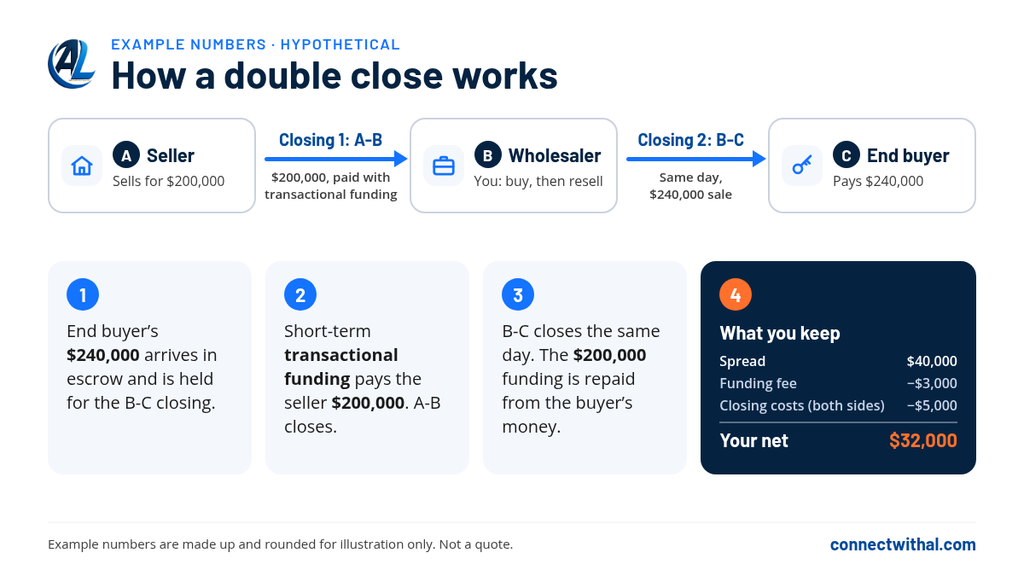
Here’s the typical order of events. Your title company and funding partner will set the exact process for your deal.
Step 1: Sign the A-B contract
You negotiate a price with the seller and sign a purchase contract, usually in your business entity’s name. Make sure the contract gives you enough time to find a buyer and close. Some states now regulate wholesale contracts with homeowners, for example by requiring written disclosures or a cancellation period, so check your state’s rules before you sign.
Step 2: Sign the B-C contract
You find an end buyer and sign a separate purchase contract to sell them the property at a higher price. The B-C closing date should line up with the A-B closing date.
If your end buyer is using a loan, confirm early that their lender will finance a same-day resale. FHA-insured loans generally can’t be used when the seller has owned the property for 90 days or less, which rules out FHA financing for the end buyer in a same-day double close. Other lenders may have their own policies on recently sold properties.
Step 3: Open escrow with a title company that handles double closes
Tell the title or escrow company up front that this is a double close. Not every title company handles them, and some need their title insurer’s approval first.
Step 4: Line up the A-B funding
If you’re not using your own cash, this is where double close funding comes in. The funding partner reviews both contracts, quotes its terms and confirms its requirements.
Step 5: The end buyer’s funds arrive in escrow
Funding partners typically require the end buyer’s money (cash or loan funds) to be received in escrow before they fund the A-B side. That money is held for the B-C closing. It doesn’t pay the seller.
Step 6: The A-B side closes
All documents are signed, the funding partner wires the purchase money, and the seller is paid. Your entity now holds title.
Step 7: The B-C side closes
Minutes or hours later, the B-C sale closes. The funding is repaid from the sale proceeds, closing costs are paid, and the rest is paid to you.
A Simple Example (Hypothetical Numbers)
These figures are made up and rounded for illustration only. They aren’t quotes, typical rates or a real deal.
- A-B purchase price: $200,000
- B-C sale price: $240,000
- Gross spread: $40,000
On closing day:
- Your end buyer’s $240,000 is received in escrow.
- A funding partner provides $200,000 to close the A-B side. The seller is paid.
- The B-C side closes. From the $240,000, the $200,000 in funding is repaid.
- Suppose the funding fee is $3,000 and your share of closing costs on both sides is $5,000.
- Your net: $40,000 – $3,000 – $5,000 = $32,000.
Your actual numbers depend on the funder’s quote, your title company’s fees and your contracts.
Costs to Plan For
A double close usually costs more than an assignment. Build these into your offer:
- The funding fee, quoted by the funding partner for your deal.
- Two sets of closing costs, one for each side, depending on how your contracts split them.
- Title insurance and escrow fees on both transactions.
- Transfer taxes and recording fees, which vary by location and may apply to both sides.
- Delay charges. Some funders charge extra if the B-C side doesn’t close on time, so ask what applies.
What Can Slow Down a Double Close
Many delays come from preparation rather than the funding itself. Watch for:
- Mismatched dates between the A-B and B-C contracts.
- End buyer delays. If your buyer’s lender is late, nothing funds.
- End buyer financing that won’t allow a same-day resale, such as an FHA loan.
- Title problems such as liens or missing signatures.
- Unsigned documents. Funding partners typically require all documents and title paperwork to be fully signed before funding.
Where We Fit
AL Innovative Services LLC is not a lender. We connect wholesalers and investors with independent funding partners. If you have both contracts signed, we can introduce you to an independent funding partner that funds the A-B side, so both closings can be funded the same day once they’re scheduled, subject to its approval. Give us at least 72 hours’ notice before closing, because the partner needs advance notice. A week, or as soon as escrow opens, is ideal. Under the partner’s current terms, there’s nothing upfront, and pricing is quoted per deal.
Here’s how it works:
- Submit your deal. The short form takes about 3 minutes. No documents needed to start. Signed A-to-B and B-to-C contracts are needed before funding.
- Get introduced. We usually review submissions within 1 business day. If the deal fits, we send one introduction email to you and the partner.
- Work with the partner directly. The partner quotes terms, collects documents, works with your title or escrow company, and provides the funding.
Need earnest money to lock up a deal first? We also connect investors with independent EMD funding sources.
Learn more about double close funding, or submit your deal now.
This article is general information, not legal or tax advice. Rules for double closings vary by state and title company, and some states regulate wholesaling or how back-to-back closings can be funded. Check with your title company (and an attorney or tax professional if needed) before you close.
FAQ: How Double Closing Works
Is a double close legal?
Double closings are widely used in real estate investing, but the rules depend on where the property is. Several states now regulate wholesaling, with requirements such as licensing, written disclosures to the seller or a cancellation period, and some of these rules may affect how a double close is set up. Title companies and their insurers may also have their own policies. Check with your title company and a local real estate attorney before you sign.
Do both closings have to happen on the same day?
Not always, but they usually do when you use double close funding, which is short-term capital built for same-day closings. If your buyer won’t be ready for days or weeks, talk with your title company and funding partner about other options.
Do I need my own money to double close?
Not necessarily. Double close funding can cover the A-B purchase, and it’s repaid from the B-C sale. You’ll still want to plan for closing costs, the funding fee and any earnest money deposit required by your contract.
Will the seller or end buyer see my profit?
Each closing has its own settlement statement, so each statement shows the figures for that transaction. That doesn’t make the A-B sale confidential. Both deeds are recorded, an end buyer’s lender or title company will typically see the prior sale, and in many states sale prices also show up in public records. Ask your title company what each party will receive.
Can double close funding be used for a home I’ll live in?
No. The funding partners we work with fund business entities and investment properties only, not owner-occupied homes or loans in your personal name.
Does AL Innovative Services LLC provide the funding?
No. We introduce you to an independent funding partner. The partner provides the funding and sets all terms.
AL Innovative Services LLC is not a lender. We introduce investors to independent funding partners, who make all funding decisions. Funding is for business entities and investment properties only, not owner-occupied homes, and nothing on this site is a commitment to fund.